
Headlines
- An End to Three Decades of Stagnation? The Full Scope of National Strategy Unveiled by Japan’s First Female Prime Minister
- Defying the Tariff War! Global Container Trade Post 10% Growth
- A Lunar New Year Without Cargo Rush — Falling Freight Rates Signal a Turning Point in the Shipping Market in 2026
- Maersk Forecasts Sharp Decline, Targets USD 180 Million in Annual Cost Savings Through Workforce Reduction
- Stonepeak Expands Into the Terminal Business
- Newbuild Container Information – February 2026
- 40% of Employee are Women, an Organizational Strategy Drives Customer Trust and Dynamic Growth
An End to Three Decades of Stagnation? The Full Scope of National Strategy Unveiled by Japan’s First Female Prime Minister
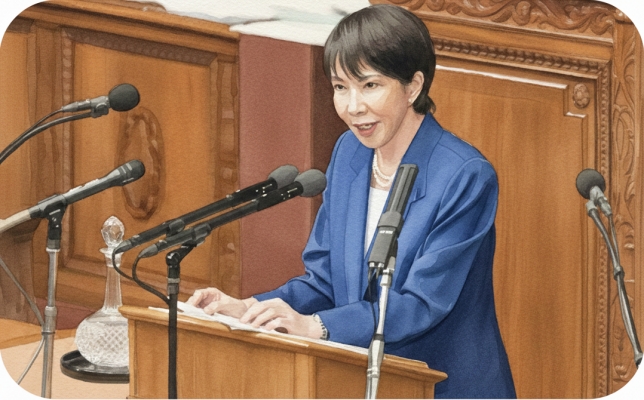
On February 8 (Sunday), Japan held its 51st House of Representatives general election. A total of 465 seats were contested — 289 from single-member districts and 176 through proportional representation. Before the election, the ruling coalition held 232 seats only (Liberal Democratic Party: 198; Japan Innovation Party: 34), falling just short of the 233 seats required for a majority. However, the final results delivered a decisive outcome: the Liberal Democratic Party secured 316 seats and the Japan Innovation Party 36, giving the ruling bloc a commanding 352 seats in total. The LDP alone surpassed two-thirds of the chamber (310 seats) which is the threshold required for the Diet to propose amendments to the Constitution to the public. It is the moment in which the Japanese people entrusted Sanae Takaichi, Japan’s first female Prime Minister, with the mission of transforming a nation burdened by three decades of economic stagnation and a political system long perceived as unable to reform itself.
Dame Takaichi graduated from the Matsushita Institute of Government and Management, founded by Konosuke Matsushita, in 1989, and has since dedicated to be a practitioner as a politician. After challenging herself for the LDP presidency three times, she succeeded on her third attempt. Last year, during the extraordinary Diet session on October 21, she was elected as Japan’s 104th Prime Minister. Since the establishment of the modern cabinet system in 1885, this marked the first time a woman has assumed the nation’s highest political office. Without belonging to any faction, without relying on factional backing, without flattery, and without yielding to political currents, her rise stands as the result of believing in her own destiny and continuing to challenge the status quo.
It may well be miraculous that Sanae Takaichi’s rise to the office of Prime Minister borders. Her steadfast commitment to a deeply principled and almost transcendent vision of political integrity created what many have called the “Takaichi effect” — the widespread belief that she could bring real change to Japan’s political system, economy, and national direction. That expectation resonated strongly with voters and ultimately helped restore the Liberal Democratic Party’s political strength.
In her speech upon being elected LDP president last year, Sanae Takaichi declared:
“Work! Work! Work! Work! I will work!” Those words convey a determination that rivals that of men, a strong will to see things through even at the cost of one’s life. It seems to declare a break from the constraints of a male-dominated society and the politics of reading between the lines. Furthermore, I believe it left a favorable impression on the vast majority of the public.
Last November, Prime Minister Takaichi stated during a Diet session that a contingency involving Taiwan could constitute a “situation threatening Japan’s survival” — the legal condition that would justify the exercise of Japan’s right of collective self-defense. In response, the Chinese government reacted strongly, beginning with inflammatory remarks from its Consul-General in Osaka, and demanded in harsh terms that she retract her statement. Since then, Beijing has imposed a series of retaliatory measures, including a suspension of seafood imports from Japan, travel advisories for its citizens visiting Japan, and export restrictions on rare earth materials, while continuing its critical stance toward Japan.
These developments are also believed to have been a significant factor behind the Japanese public’s decision to grant overwhelming majority support to the Takaichi administration and to the ruling Liberal Democratic Party in the election.
The Takaichi administration has placed priority on strengthening Japan’s national capabilities through public investment in 17 strategic sectors, with the aim of achieving economic growth and, through that growth, restoring fiscal health. This approach is grounded in a national strategy that views investment in advanced technologies, energy, logistics, and defense as a means of expanding Japan’s security and resilience.
The seventeen priority sectors are: 1) AI and semiconductors, 2) Shipbuilding, 3) Quantum technologies, 4) Synthetic biology and biotechnology, 5) Aviation and space, 6) Digital technology and cybersecurity, 7) Content industries (anime, games, manga, and film), 8) Food technology, 9) Resources, energy security, and green transformation (GX), 10) Disaster prevention and national resilience, 11) Drug discovery and advanced medical care, 12) Advanced materials and critical minerals, 13) Fusion energy, 14) Port logistics, 15) Defense industry, 16) Information and communications, 17) Ocean industries.
These fields are broadly grouped into three categories — technological foundations (such as AI and quantum), industrial clusters (including shipbuilding and defense), and infrastructure and quality-of-life sectors (such as ports and healthcare). They are interconnected through the common goals of domestic capability, high value-added development, digital transformation, and national security. The government plans to concentrate public and private investment in each area to reinforce supply chains and accelerate technological innovation. As Prime Minister Takaichi has declared, “Japan is back!”, we do hope that Japan’s economy will indeed regain its strength and become a nation capable of making even greater contributions to the world.
Defying the Tariff War! Global Container Trade Post 10% Growth
I would also like to share some encouraging news: global containerized cargo volumes continue to grow steadily year after year, regardless of external challenges. According to data from Container Trades Statistics (CTS), the trend in global container transport volumes over the past four years has been as follows:
2022: 172.1 million TEU
2023: 173.0 million TEU (+1% year-on-year)
2024: 184.3 million TEU (+7%)
2025: 192.9 million TEU (+10%)
These figures almost suggest that global trade has been resilient enough to absorb even the impact of the tariff policies introduced by Donald Trump in 2025. The expansion in cargo flows reflects continued global growth, the dynamism of international trade, rising consumption in emerging economies, the rapid spread of e-commerce, and the ongoing evolution of supply chains. Naturally, global population growth also plays a significant supporting role. According to United Nations statistics, the world’s population stood at 8.27 billion as of January 1, 2026, and is projected to reach 9.7 billion by 2050, just 25 years from now. What, then, will the container shipping industry look like at that time? How large will global container fleets be? What new vessel designs and container types or sizes will emerge? The possibilities invite endless curiosity.
A Lunar New Year Without Cargo Rush — Falling Freight Rates Signal a Turning Point in the Shipping Market in 2026
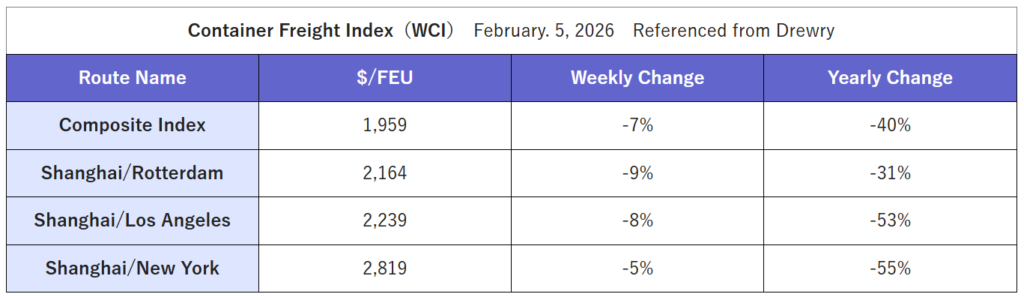
According to Drewry Shipping Consultants, the composite index of the World Container Index (WCI) declined by 7% week-on-week to USD 1,959 per FEU, marking the fourth consecutive weekly decrease. This year, the usual pre–Lunar New Year surge in cargo volumes from China and the rest of Asia to the United States did not materialize. While container carriers have been implementing additional blank sailings in response to weaker demand, Drewry expects spot freight rates to decline further in the near term. Drewry’s Cancel Sailing Tracker, released on the 6th, indicates that the blank sailing rate on the major East–West trade lanes will reach 18% during Weeks 7 to 11 (February 9–March 15). Of the total blank sailings, 63% are on the trans-Pacific eastbound trade, the largest share, followed by 14% on the Asia–Europe/Mediterranean routes and 7% on the trans-Atlantic trade. Short-term container freight rates from Asia to Europe and North America have been trending downward since January. This softening is attributed not only to sluggish pre–Lunar New Year cargo movements, but also to a loosening supply–demand balance caused by an increase in available vessel capacity.
Maersk Forecasts Sharp Decline, Targets USD 180 Million in Annual Cost Savings Through Workforce Reduction
Maersk, the Danish shipping giant, announced on February 5 — in conjunction with the release of its results for the fiscal year ending December 2025 — that it plans to reduce up to 1,000 positions out of approximately 6,000 corporate roles worldwide, including at its headquarters, in 2026. The move reflects expectations that the resumption of transits through the Suez Canal by major container carriers will significantly soften vessel demand and lead to declining freight markets. The company anticipates annual cost savings of USD 180 million as a result.
For the full year 2026, Maersk forecasts EBITDA of USD 4.5–7.0 billion, a substantial decline from the USD 9.5 billion recorded for the year ending December 2025. It also projects EBIT to range from a loss of USD 500 million to a profit of USD 1.0 billion, underscoring a challenging earnings outlook.
Stonepeak Expands Into the Terminal Business
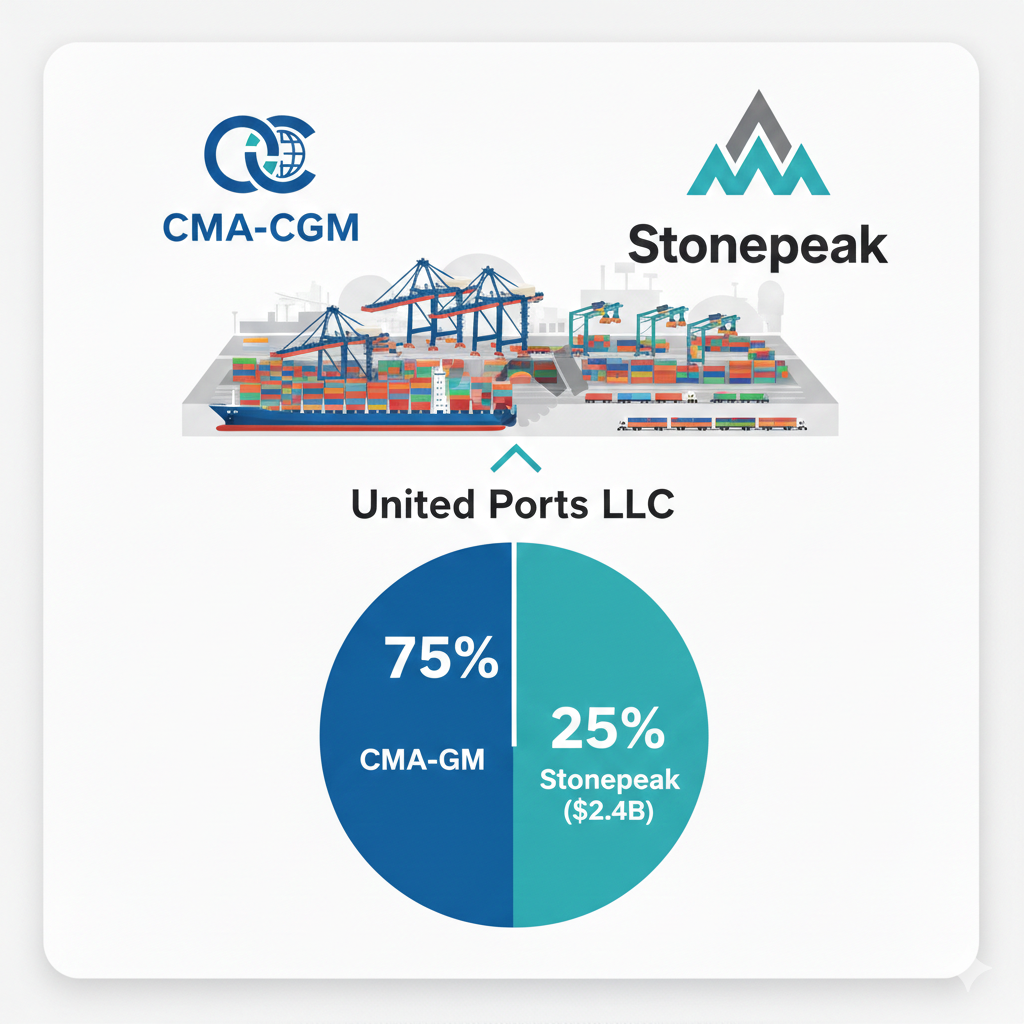
Meanwhile, CMA CGM announced on January 28 that it has agreed with U.S.-based infrastructure investment firm Stonepeak to establish a joint venture for terminal operations under the name United Ports LLC. The equity structure will be 75% held by CMA CGM and 25% by Stonepeak, with Stonepeak investing USD 2.4 billion.
The new company will operate ten major terminals across six countries currently managed by CMA CGM. CMA CGM plans to reinvest the USD 2.4 billion raised into the continued growth of its core business. Stonepeak has also indicated that it may commit an additional USD 3.6 billion to future joint terminal projects. Notably, Stonepeak is also the parent company of container leasing firm Textainer.
Newbuild Container Information – February 2026
The price of newly built containers in January stood at USD 1,550 per 20-foot unit. Although steel and flooring material prices have been trending downward, container prices remained at December levels. This price stability is likely attributable to the fact that January recorded the highest shipment volume for the month in the past year. Total new container production in January reached 567,167 TEU (Dry: 522,847 TEU, Reefer: 44,320 TEU). Compared with December, this represents an increase in total output of +32,688 TEU (Dry: +39,880 TEU; Reefer: −7,192 TEU), corresponding to a 6% overall rise in production (Dry: +8%; Reefer: −14%). Production of dry containers expanded, while reefer output declined.
Factory inventory levels at the end of January totaled 1,616,668 TEU (Dry: 1,555,504 TEU, Reefer: 61,164 TEU). Compared with the previous month, inventories decreased by 46,437 TEU (Dry: −43,895 TEU; Reefer: −2,542 TEU), equivalent to a 3% overall reduction (Dry: −3%; Reefer: −4%). Total factory shipments in January amounted to 613,604 TEU (Dry: 566,742 TEU, Reefer: 46,862 TEU). This was the third-highest monthly shipment volume recorded over the past year, making January a particularly strong month for deliveries.
40% of Employee are Women, an Organizational Strategy Drives Customer Trust and Dynamic Growth

The growing presence and achievements of our female employee is truly remarkable. Of our current workforce of 38 employees, 14 are women, representing nearly 40% of our team. They stand on the front lines as key leaders in the sales of our core products, playing vital roles in our daily operations. Their attentive and thoughtful service has earned deep trust and strong support from many of our customers. Their contributions have been a driving force behind our company’s dynamic growth. We are convinced that without the active participation of women, there can be no future for EFI.
In order to enhance the global recognition of highly capable Japanese women, and as Japanese citizens who value peace, equality, and fairness, we also hope that Prime Minister Sanae Takaichi not only to lead Japan, but to contribute to peace and stability around the world. We likewise look forward to the continued success of the women serving in her cabinet, including Satsuki Katayama, Minister of Finance, and Kimi Onoda, Minister for Economic Security.