
Headlines
- A Looming Global Crisis! Prolonged Closure of the Strait of Hormuz Shakes Energy and Shipping Markets
- Is the Decline in Imports Temporary? Resilient Supply Chains Reveal Opportunities
- Hapag-Lloyd’s ZIM Acquisition and Leadership Change at ONE – Steering Through a New Wave of Industry Restructuring
- Container Freight Indices Update ~ Unavoidable Rising Logistics Costs as Tensions Mount in the Strait of Hormuz
- Newly Built Container Information in March 2026 ~ Output Down 66%、Yet Factory Slots Sold Out Through May
- Swift Strategic Oil Release! Prime Minister Takaichi Signals Japan’s Leadership Ahead of U.S. Summit
A Looming Global Crisis! Prolonged Closure of the Strait of Hormuz Shakes Energy and Shipping Markets
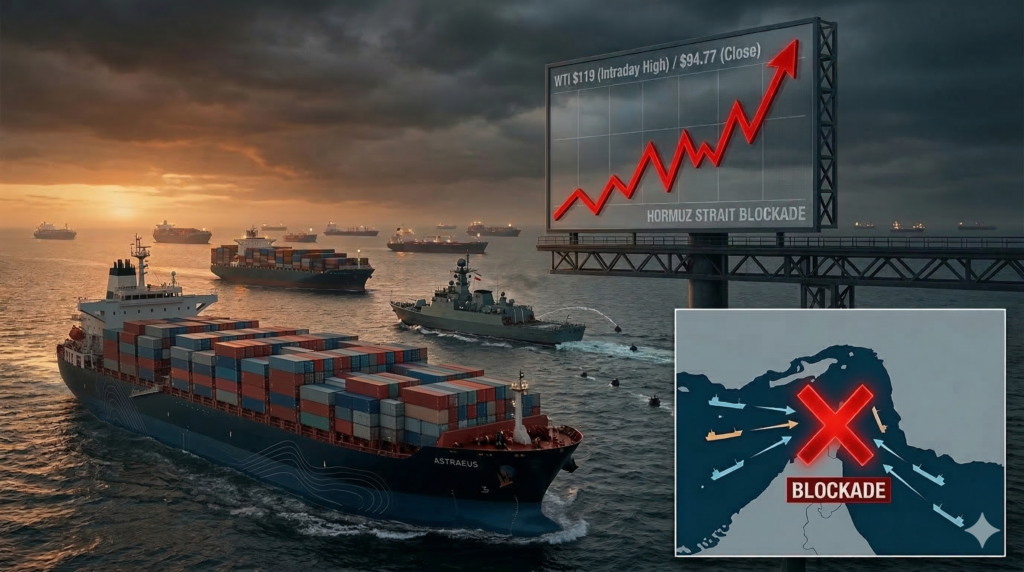
On February 28, shocking news emerged that the United States and Israel had launched an attack on Iran. The strike reportedly resulted in the death of Iran’s Supreme Leader, Ayatollah Ali Khamenei. In retaliation, Iran carried out ballistic missile and drone attacks on U.S. military bases across the Gulf region, escalating the conflict.
The Strait of Hormuz accounts for approximately 20% of the world’s oil transportation. Iran subsequently blockaded the strait. By March 2, three merchant vessels had reportedly been attacked, resulting in casualties among crew members. As a result, commercial vessels have been unable to transit the strait. As of March 8, more than 130 container ships are said to be trapped in the Persian Gulf, while 62 vessels are waiting outside the Strait of Hormuz. A container ship operated by Ocean Network Express (ONE) was also reportedly attacked.
On March 9, Mojtaba Khamenei, the 56-year-old son of the late Supreme Leader and a conservative hardliner known for his strong anti-U.S. stance, was selected as his successor. This development raises the possibility that Iran may adopt an even more hardline posture. On the same day, U.S. crude oil futures prices (WTI) briefly surged to a high of $119 per barrel before falling by about $40 to $81.19 per barrel, eventually closing at $94.77 per barrel. This marked the highest level in approximately three and a half years.
Iran has reportedly laid naval mines in the Strait of Hormuz in an effort to prolong the blockade. The move is aimed at dealing a blow to the Trump administration, while also increasing the economic burden on countries dependent on oil supplies from the Gulf region and causing significant disruption through potential reductions in oil production by Gulf states. Concerns over the escalation and prolonged duration of the Middle East conflict have already triggered a sharp rise in crude oil prices, casting a shadow over the global economy.
Shipping lines have suspended the acceptance of bookings to/from the Middle East services. In addition, following the announcement by Yemen’s Houthi rebels that they would resume attacks in the Red Sea, Maersk and Hapag-Lloyd of the Gemini Alliance, who had gradually shifted their India-Middle East/Mediterranean services back to the Suez Canal route since February, have once again been forced to reroute vessels via the Cape of Good Hope.
As of March 2, CMA-CGM has introduced an Emergency Conflict Surcharge (ECS) on cargo destined for the Persian Gulf, the Red Sea, and certain East African ports, while Hapag-Lloyd has imposed a War Risk Surcharge (WRS).
Is the Decline in Imports Temporary? Resilient Supply Chains Reveal Opportunities
On March 9, the National Retail Federation (NRF) and Hackett Associates released actual figures and updated forecasts for retail-related import cargo handled at major U.S. ports. Retail imports in January 2026 totaled 2.08 million TEU, down 6.4% from the same month a year earlier. Imports in February are projected at 2.01 million TEU, a decline of 1.3% year-on-year. The forecast for the following months is 1.91 million TEU in March (down 11.2%), 2.03 million TEU in April (down 8.1%), 2.09 million TEU in May (up 7.0%), 2.10 million TEU in June (up 6.8%), and 2.20 million TEU in July (down 8.0%). However, the report also warns that U.S. tariff issues, rising crude oil and gasoline prices due to the prolonged Iran conflict, increased pressure on consumer spending, and higher manufacturing costs could lead to a decline in containerized import volumes.
According to statistics compiled by the Japan Maritime Center, the following container cargo volumes were recorded in 2024 for the Asia–North America and Asia–Europe trade routes.
| Asia/North America | North America/Asia | Asia/Europe | Europe/Asia | |
| 2024 | 21,650,687 TEU | 5,762,717 TEU | 18,181,297 TEU | 6,325,288 TEU |
These volumes represent the annual container flows between Asia and North America as well as between Asia and Europe. These trade flows have already been firmly established as part of the global supply chain, and volumes close to these levels continue to move between Asia, North America, and Europe under almost any circumstances. Even when temporary disruptions occur—such as city lockdowns during the COVID-19 pandemic that temporarily halted logistics—minimum essential cargo flows cannot be stopped. Moreover, demand surges such as the “stay-at-home demand” and the subsequent “revenge consumption,” which were particularly evident in North America, can create even stronger waves in logistics activity. Global logistics will not come to a halt. Shipping lines and all stakeholders involved must remain prepared for such dynamics.
Hapag-Lloyd’s ZIM Acquisition and Leadership Change at ONE – Steering Through a New Wave of Industry Restructuring
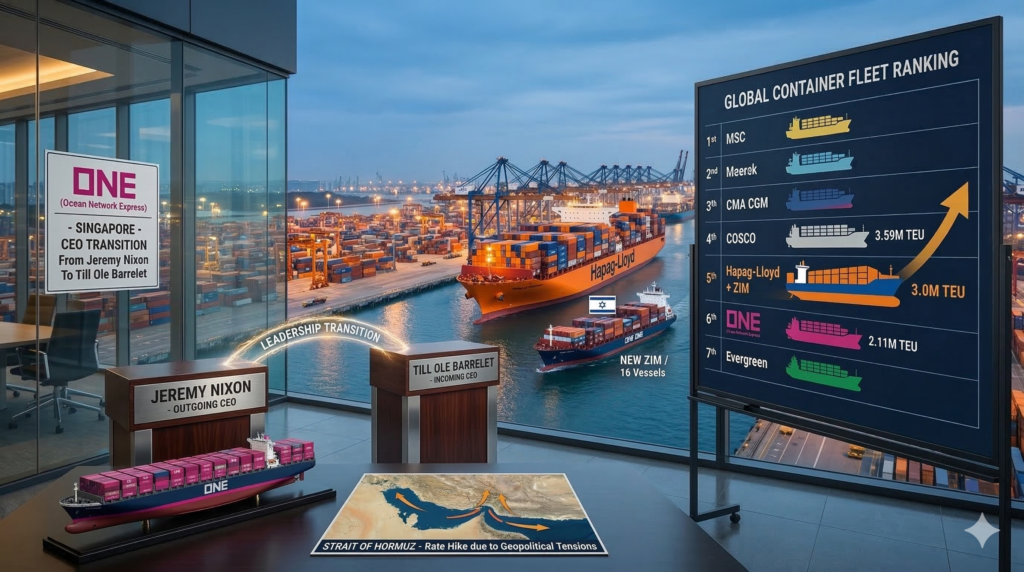
On February 16, Hapag-Lloyd announced that it would acquire ZIM. Following the acquisition, Hapag-Lloyd’s operated container fleet will exceed 400 vessels with a total capacity of more than 3 million TEU, and its annual transport capacity will surpass 18 million TEU, making it the world’s fifth-largest container shipping line. This will bring the company close to COSCO, currently ranked fourth with 3.59 million TEU of capacity, while significantly widening the gap with Ocean Network Express (ONE), which ranks sixth with 2.11 million TEU. Meanwhile, the “golden share” held by the Israeli government will be transferred to FIMI Opportunity Funds, a private Israeli investment fund, in order to address Israel’s national security concerns. A new entity, “New ZIM,” will be established with 16 Israeli-flagged vessels to continue liner services to and from Israel. Hapag-Lloyd will also provide commercial support to “New ZIM,” including access to its network with Maersk and participation in the Gemini Cooperation network.
On February 25, Ocean Network Express (ONE) announced that Till Ole Barrelet will assume the position of CEO effective July 1.
ONE, the container shipping company established through the integration of the liner businesses of Japan’s three major shipping lines—NYK Line, MOL, and K Line—was launched in July 2017 with Jeremy Nixon as its founding CEO. At that time, the liner divisions of the three Japanese carriers belonged to different shipping alliances and had become severely weakened by intense freight rate competition.
Compared with other profitable sectors such as car carriers, bulkers, and tanker operations, the liner divisions were often regarded as burdens that generated little profit. Following the bankruptcy of South Korea’s Hanjin Shipping in August 2016 and the rapid upsizing of container vessels on the Europe trade, it became increasingly difficult for each company to sustain independent liner operations. As a result, the three Japanese carriers set aside their pride and decided to integrate their container shipping businesses, leading to the establishment of ONE. It was undoubtedly a bold decision—without it, Japan’s liner shipping industry might not have survived to the present day.
In its first year after launch, ONE posted a loss due to system-related issues. However, under the leadership of CEO Jeremy Nixon, the company gradually began to benefit from economies of scale. The decision to locate its headquarters in Singapore also appears to have contributed to its success.
Furthermore, the extraordinary surge in freight rates that followed the outbreak of the COVID-19 pandemic in 2020 provided a significant tailwind. As a result, ONE generated profits amounting to several trillion yen for its three parent companies, delivering remarkable returns.
Freight rates had been trending downward since the second half of last year. However, the closure of the Strait of Hormuz following the attack on Iran by Israel and U.S. President Trump has shifted the market back toward an upward trend. It is under these circumstances that the leadership transition at ONE will take place.
I had the opportunity to meet Mr. Nixon for the first time at the Yokohama Maritime Forum held in October 2019. His friendly personality immediately made me a fan. I would like to express my appreciation for both his character and his outstanding leadership.
Drewry released its latest container freight rate index on March 5.
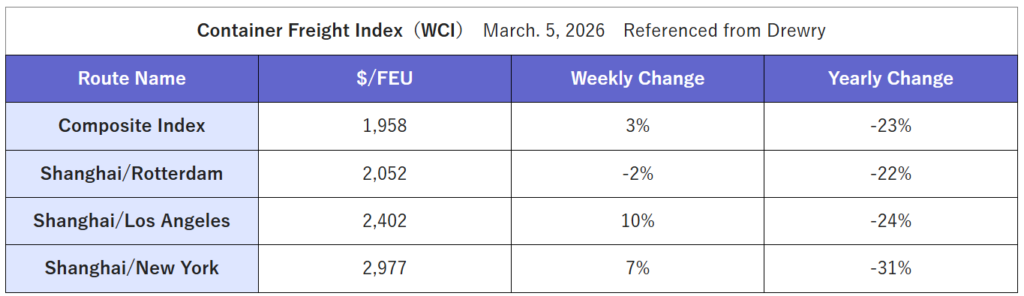
The Drewry World Container Index (WCI) composite index increased by 3% week-on-week to $1,958 per FEU. As blank sailings on the major east–west routes continue to be maintained, Drewry expects spot rates to rise further over the coming weeks.
At present, tanker movements through the Strait of Hormuz—through which roughly 20% of the world’s oil supply passes—have effectively been frozen, pushing crude oil prices upward. If this situation persists, higher bunker fuel prices, increased war-risk insurance premiums, and operational disruptions could drive up overall cargo transportation costs, placing upward pressure on container freight rates.
Newly Built Container Information in March 2026 ~ Output Down 66%、Yet Factory Slots Sold Out Through May
The price of newly built containers in February remained at $1,550 per 20-foot unit. Flooring materials increased somewhat in price, while steel prices remained almost unchanged from the previous month. Although there is a general upward trend in material costs, container prices were maintained at the same level as in January.
Total new container production in February amounted to 191,782 TEU (Dry: 169,797 TEU; Reefer: 21,985 TEU). Compared with the previous month, overall production decreased by 375,385 TEU (Dry: -353,050 TEU; Reefer: -22,335 TEU), representing a 66% decline in total output (Dry: -68%; Reefer: -50%). Both dry and reefer containers saw production reductions of roughly 50–70%.
The primary reason for the sharp decline was the Lunar New Year holiday, during which container factories suspended production lines for nearly one month. Unfortunately, this year did not see the usual cargo rush ahead of the Lunar New Year.
As of the end of February, total inventories at container factories stood at 1,473,099 TEU (Dry: 1,426,314 TEU; Reefer: 46,785 TEU). Compared with the previous month, total inventories declined by 143,569 TEU (Dry: -129,190 TEU; Reefer: -14,379 TEU), representing a decrease of 9% overall (Dry: -8%; Reefer: -24%).
Total factory shipments in January amounted to 335,351 TEU (Dry: 298,987 TEU; Reefer: 36,364 TEU). Container factory operating rates are currently estimated at around 30%, although it is said that production slots at factories are already fully booked through May.
Swift Strategic Oil Release! Prime Minister Takaichi Signals Japan’s Leadership Ahead of U.S. Summit
Prime Minister Sanae Takaichi will visit the United States on March 19 for a summit meeting with President Trump.
Allow me, somewhat abruptly, to say a few words about the character of the Japanese people. We value equality and respect the human rights of others. Since ancient times, harmony has been highly cherished in Japanese society. We keep our promises once decisions are made. We respect those who excel in their respective fields, and we listen seriously and attentively to what others say. Traditionally, men have taken responsibility for work while women have taken responsibility for the household. Women may appear modest, yet they form the very core of the family, while men find themselves dance on the palm of women’s hand
Prime Minister Takaichi, much like the late Prime Minister Shinzo Abe, respects her counterparts and, when necessary, knows how to support and elevate them. At the same time, she is a person of strong conviction and unwavering principles. On March 11, without waiting for a decision from the International Energy Agency (IEA), she announced that Japan would independently release oil from its strategic reserves, with implementation beginning on the 16th. The objective is to ease gasoline prices and relieve public anxiety.
A swift and decisive decision. President Trump will likely be impressed by Prime Minister Takaichi’s decisiveness, the strength of character she represents as a Japanese woman, and her deep sense of generosity. There is a reason why Sanae Takaichi became the first woman in Japan’s history to be chosen as the nation’s top political leader.
Italy’s Prime Minister Giorgia Meloni has been described as a leader who skillfully balances two faces—one that appeals to the emotions of the public and another that demonstrates the sound judgment required to gain the trust of the international community. She is also known for her charismatic personality. Prime Minister Takaichi possesses a comparable sense of leadership and character. I am confident that her meeting with President Trump will prove fruitful and will contribute greatly to the cause of world peace.