
Headlines
- America at 250: Rising Tensions with Iran and the Future of the M&A Boom
- 7,000 Lives Lost: How Extreme Weather Is Reshaping Global Supply Chains
- Global Trade Shows Signs of Recovery as Container Indices Rise and the Red Sea Route Reopens
- Top 10 Carriers Control Over 80% of the Market as Freight Rates Double – The Changing Landscape of Global Container Shipping
- Container Manufacturing Shifts Beyond China as India and Asia Redefine Supply Chains
- ONE Mandates ISO-Compliant Security Seals to Strengthen Supply Chain Security
- Container Prices Hold Firm Despite Lower Costs as Shipments Reach a New High for the Year
- Exclusive Partnership with Spain’s Leading EMBALEX Brings Advanced Thermal Liner Solutions to Japan
America at 250: Rising Tensions with Iran and the Future of the M&A Boom

The United States celebrated the 250th anniversary of its independence on July 4. A commemorative ceremony was held in Washington, D.C., where an astonishing 850,000 fireworks were reportedly launched—some 40 to 50 times more than in a typical year. It is almost impossible to imagine such an extraordinary spectacle. For comparison, the famous Sumida River Fireworks Festival, one of Japan’s iconic summer events, features approximately 20,000 fireworks, while the Suwa Lake Fireworks Festival, the country’s largest, displays around 40,000. When the United States celebrated its Bicentennial in 1976, I happened to be stationed in New York. I had heard that around 100 tall ships would gather near the Statue of Liberty on the Hudson River, so I made my way to Battery Park at the southern tip of Manhattan to witness the historic occasion. I do not know how many people were there, but I still vividly remember the thunderous cheers that grew louder as I left the subway station and approached the waterfront. Although the United States is often described as a society marked by significant wealth disparity—with the wealthiest one percent holding around 30 percent of the nation’s wealth—it remains, in my eyes, a country where people can still dream big.
Another shocking development has emerged. On July 7, the U.S. Treasury Department announced the reinstatement of sanctions on Iranian crude oil and petrochemical products. The move is widely seen as a response to Iran’s attacks on three merchant vessels transiting the Strait of Hormuz. On the same day, the U.S. Central Command (CENTCOM) also launched a series of major military strikes against Iran. Following the signing of a memorandum on June 17 aimed at ending the hostilities, the United States and Iran had agreed to suspend sanctions for a two-month period from June 21 to August 21, allowing the import and export of Iranian crude oil and other products. The two countries had been negotiating a final agreement to bring the conflict to an end. However, this latest exchange of attacks has cast renewed doubt over the prospects for ending the Iran conflict.
According to the U.S. employment report for June, released by the Department of Labor on July 2, nonfarm payroll employment increased by 57,000 from the previous month. Through May, monthly job gains had consistently exceeded 100,000. The unemployment rate declined by 0.1 point to 4.2%, marking its lowest level in a year. Average hourly earnings rose 3.5% year-on-year, accelerating slightly from the 3.4% increase recorded in May. Overall, U.S. consumer spending has remained resilient. Real Personal Consumption Expenditures (PCE), adjusted for inflation, increased by 0.3% month-on-month in May on a seasonally adjusted basis, rebounding after remaining flat in April. Despite growing concerns over the economy, America remains stronger than many had expected.
According to the London Stock Exchange Group (LSEG), mergers and acquisitions (M&A) involving U.S. companies totaled US$1.4467 trillion (approximately ¥230 trillion) during the first half of 2026, representing a 75% increase compared with the same period last year. This marks the highest first-half total since comparable records began in 2002. The technology sector accounted for the largest share of deal activity. Many analysts expect the M&A boom to continue over the next several years, driven by intensifying competition in artificial intelligence (AI) and deregulatory policies under the Trump administration. If this trend continues, the strong M&A market is also likely to further strengthen President Trump’s position.
On June 25, New York City decided to freeze rents for one year beginning in October for approximately one million rent-regulated apartments, representing roughly 40% of the city’s rental housing stock. According to a U.S. real estate website, the average monthly rent for a one-bedroom apartment in New York City reached US$3,350 (approximately ¥540,000) in 2024, an increase of about 20% over the past five years. As the prolonged period of inflation has continued to drive up the cost of living, it is estimated that one in four New York City residents now lives in poverty.
7,000 Lives Lost: How Extreme Weather Is Reshaping Global Supply Chains
Europe is being hit by an intense heatwave. On July 1, Spain’s health authorities reported that more than 1,000 people had died as a result of the June heatwave. France’s Public Health Agency estimates that the extreme heat has claimed approximately 1,000 lives since June 24. Germany’s Federal Statistical Office announced that, during the heatwave in late June, the country recorded more than 5,000 excess deaths compared with normal mortality levels. According to the German Meteorological Service, temperatures exceeded 40℃ at approximately 50 weather stations across the country by June 27. Air-conditioning remains uncommon in Germany and France. It is said that only about 4% of new homes completed in Germany in 2025 were equipped with air-conditioning systems. The heatwave is also affecting the logistics sector. On Germany’s Autobahn network, high temperatures have damaged road surfaces, resulting in temporary road closures and speed restrictions. There have also been disruptions to tram services after tracks became deformed by the extreme heat.
On June 11, the U.S. National Oceanic and Atmospheric Administration (NOAA), followed by the World Meteorological Organization (WMO) on July 3, officially declared that an El Niño phenomenon had begun, with sea surface temperatures remaining high in the waters stretching westward from the coast of Peru in South America. They stated that this event may rank as one of the largest “Super El Niño” phenomena in the historical records dating back to 1950. In 2023, the Panama Canal was significantly affected by transit restrictions caused by water shortages. Shippers using the Panama Canal need to consider alternative routes in preparation for possible future transit restrictions.
Global Trade Shows Signs of Recovery as Container Indices Rise and the Red Sea Route Reopens
According to the Leibniz Institute for Economic Research (RWI) and the Institute of Shipping Economics and Logistics (ISL), the preliminary seasonally adjusted Global Container Throughput Index for May rose by 0.3 points to 141.9, from the revised 141.6 recorded in the previous month. They stated that the index has stabilized following declines in March and April. The North Range Index for the major ports in Northern Europe increased by 0.4 points, from the revised 119.6 in the previous month to 120.0. In contrast, the container throughput index for Chinese ports declined by 1.3 points, from the revised 158.9 to 157.6. Overall, they stated that the pressure on global trade caused by higher crude oil prices resulting from the Iran conflict has eased, and that global trade has shown greater resilience than had originally been expected.
Maritime research company Sea-Intelligence stated on July 2, based on its analysis of the Port Liner Shipping Connectivity Index (PLSCI) for the second quarter of 2026 published by the United Nations Conference on Trade and Development (UNCTAD), that a structural shift is taking place as container shipping lines move transshipment activities away from major hub ports and toward regional transshipment hubs. In other words, the shipping network centered on Singapore, one of the world’s major hub ports, is showing signs of contraction, while ports in India and the Middle East are strengthening their presence as new regional transshipment hubs.
Maersk and Hapag-Lloyd announced on July 6 that they will gradually shift their Gemini Cooperation services from the current Cape of Good Hope route back to the Red Sea and Suez Canal route. They stated that the safety of their crews, vessels, and cargo will remain their highest priority. Should the security situation deteriorate, individual voyages or even the entire service network may be redirected via the Cape of Good Hope once again.
Top 10 Carriers Control Over 80% of the Market as Freight Rates Double – The Changing Landscape of Global Container Shipping
According to Alphaliner, below are the Top 10 liner shipping companies as of June, ranked by operating capacity, fleet size, and global market share.
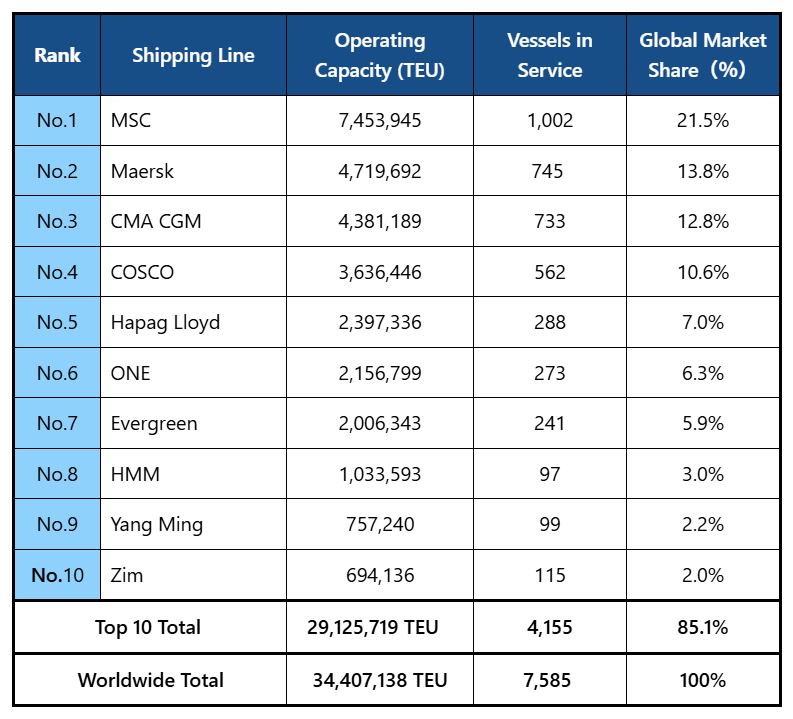
The Top 10 liner shipping companies now account for more than 80% of the global container shipping market.
Note 1
Israel’s Minister of Defense has issued an official statement opposing the proposed acquisition of ZIM by Hapag-Lloyd, citing concerns over potential risks to Israel’s maritime security and supply chain. As regulatory approval for the acquisition has not yet been formally completed, the two companies are listed separately.
Note 2
As of June 10, MSC was operating 1,002 vessels, becoming the first shipping company in the world to operate a fleet of more than 1,000 vessels.
Note 3
It has been reported that MSC is interested in acquiring a stake in Hapag-Lloyd. A binding agreement among the major shareholders, which had been due to expire in 2026, has been extended until 2030. However, the situation beyond that remains uncertain.
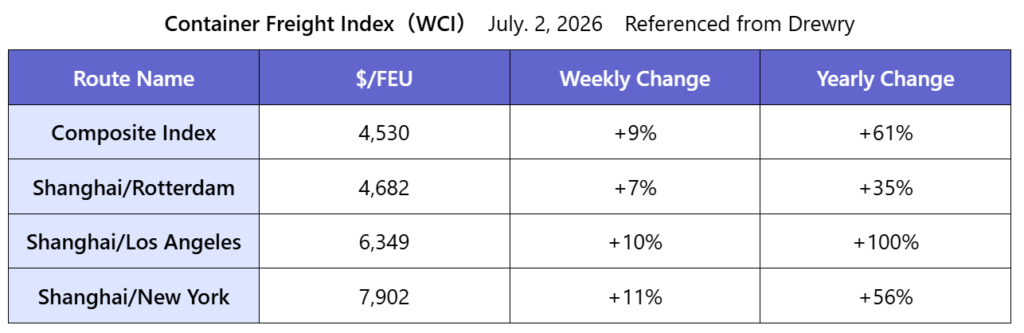
Reflecting the tight supply of vessel capacity, eight blank sailings have been announced on the Trans-Pacific trade for next week. Carriers continue to announce General Rate Increases (GRIs) and Peak Season Surcharges (PSSs) for July in anticipation of increased cargo volumes. According to Drewry, spot freight rates are expected to rise further in the coming weeks. Drewry also stated that the East-West container freight market has remained resilient, supported by seasonal peak demand and higher shipping costs resulting from geopolitical disruptions. Meanwhile, although an interim agreement has been reached to reopen the Strait of Hormuz, security risks remain elevated following an attack on a containership near Oman. The current situation suggests that security concerns in the region remain high.
Container Manufacturing Shifts Beyond China as India and Asia Redefine Supply Chains
Maersk unveiled on July 3 the first ISO container manufactured in India by its joint venture container manufacturing company with CONCOR (Container Corporation of India). At the same time, Maersk placed an additional order for 1,000 containers. This move reflects the shift in container export production from China to Southeast Asia and India. Last year, CMA CGM became the first shipping line to procure 1,000 20f ISO containers from Hoa Phat, a container manufacturer in Vietnam. Diversifying procurement sources and manufacturing containers closer to demand areas can shorten turnaround times and improve supply chain efficiency. As supply chains continue to shift toward India and other Asian countries, container manufacturing is expected to move further away from China.
ONE Mandates ISO-Compliant Security Seals to Strengthen Supply Chain Security

Ocean Network Express (ONE) launched its new management team on July 1. Till Ole Barrelet has been appointed as the new Chief Executive Officer (CEO), while former CEO Jeremy Nixon has assumed the role of Senior Adviser. This is the first change of CEO since ONE was established in April 2018. In April, a new executive leadership team consisting of seven executives was formed, introducing a new management structure under which the regional leaders report directly to the CEO. ONE plans to expand its operating fleet capacity from the current approximately 2.2 million TEU to 3.0 million TEU by 2030. We look forward to the success of ONE’s new management team.
On June 25, Ocean Network Express (ONE) announced that, in order to enhance the security of its customers’ cargo, it will require the use of container seals compliant with the international standard ISO 17712:2013 throughout its managed supply chain. All High Security Seals manufactured by TydenBrooks, which are supplied by our company, fully comply with this international standard. In particular, the Super Bolt Seal cannot be cut even when subjected to a shearing force of more than 4.5 metric tons. For this reason, it has been widely used by our customers to help prevent cargo theft during rail transportation across the United States. As ONE also uses these seals, we would like to take this opportunity to recommend them to our customers.
Container Prices Hold Firm Despite Lower Costs as Shipments Reach a New High for the Year
The price of a new standard dry container remained unchanged at US$1,750 per 20-foot container in June, the same as in May. This marks the third consecutive month at the same price. Prices of steel, flooring materials, and paint each declined by several percent from the previous month. However, we believe these cost reductions were not reflected in container prices because manufacturers decided to maintain prices in anticipation of stronger demand during the summer peak season. New container production totaled 665,545 TEU (Dry: 626,855 TEU; Reefer: 38,690 TEU). Compared with the previous month, production increased by 75,077 TEU (Dry: +74,526 TEU; Reefer: +551 TEU), representing an increase of 12.7% (Dry: +13.5%; Reefer: +1.0%). Dry container production continued to accelerate, reaching its highest level so far this year. Factory inventories of new containers at the end of June stood at 1,483,248 TEU (Dry: 1,421,188 TEU; Reefer: 62,060 TEU). Compared with the end of May, total inventories decreased by 72,598 TEU (Dry: -76,444 TEU; Reefer: +3,846 TEU), or 4.7% overall (Dry: -5.1%; Reefer: +6.6%). Factory shipments in June totaled 738,143 TEU (Dry: 703,299 TEU; Reefer: 34,844 TEU). This represented an increase of 31% overall (Dry: +33%; Reefer: -3.5%). Dry container shipments reached their highest level of the year. We believe that the strong shipment volume led to an increase in new container orders during June.
Exclusive Partnership with Spain’s Leading EMBALEX Brings Advanced Thermal Liner Solutions to Japan
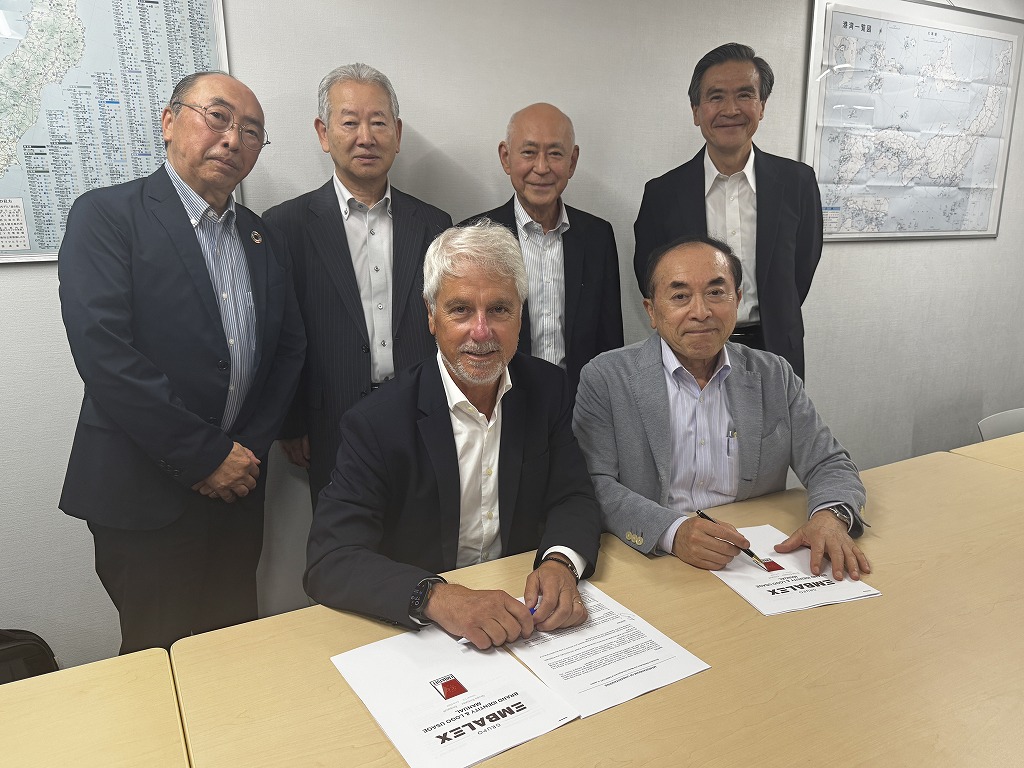
We are pleased to announce that EF International Ltd. has been appointed as the exclusive dealer in Japan for EMBATUFF, the thermal container liner developed by Spain’s EMBALEX, a company with a history spanning 108 years. On June 26, Mr. José Antonio Alonso, CEO of EMBALEX, visited Japan, and we signed a Memorandum of Understanding (MOU) establishing our partnership. Founded in 1918, EMBALEX is widely recognized as a leading company in the fields of industrial packaging materials and logistics solutions, with an established reputation throughout Europe, North America, and South America. EMBATUFF has obtained utility model protection covering both the product itself and its installation method inside containers in 42 countries and regions, including Japan. In addition, EMBATUFF offers a wide range of products, providing the flexibility and originality to meet a broad variety of customer requirements. We are confident that it will achieve a high level of customer satisfaction.
We are truly honored to have the opportunity to introduce EMBALEX’s outstanding products to customers throughout Japan.