
Headlines
- Strong U.S., Stagnant Europe, and a Slowing China—The Global Economy Splits into Three in 2026
- U.S.-Flagged Fleet Share Below 1% — Proposal for a Public Container Shipping Option Signals Growing Concern
- Lessons from the Rise and Fall of U.S. Shipping Lines — What Should Japanese Container Carriers Do Next?
- China’s Export Rush Ahead of the Seven-Day Holiday — Where Are Freight Rates Heading?
- Freight Rates Top US$10,000 and 4.3 Million TEU Congested in Port — Extraordinary Situation Since the COVID-19 Pandemic
- Nuclear Power, Rotor Sails and the Arctic Route — Three Innovations Changing the Future of Shipping
- New Container Prices Stay Flat for Six Months — Production Quietly Passes Its Peak
- Verified by NKKK, Installed in Just 5 Minutes — A Thermal Liner to Protect Your Cargo
Strong U.S., Stagnant Europe, and a Slowing China—The Global Economy Splits into Three in 2026
As for the current situation of the U.S.-Iran war, although the “Islamabad Memorandum of Understanding (Islamabad MoU)” was concluded on June 17, 2026, it expired 60 days later on August 17 without any clear agreement being reached on its extension, and localized fighting still continues. It seems like that U.S. President Trump is also realistically unable to launch any large-scale military strategy until the results of the November 3 midterm elections.
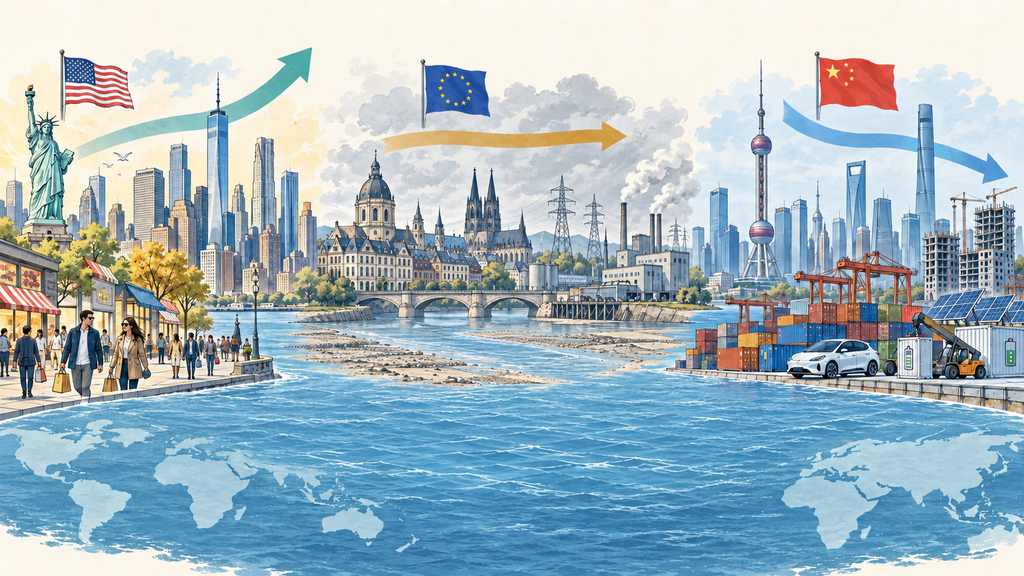
The U.S. employment report released by the Department of Labor on September 4 came as a major surprise, with nonfarm payrolls increasing by 162,000, far exceeding the pre-release forecast of approximately 55,000. The unemployment rate remained unchanged from the previous month at 4.1%. Strong summer holiday demand, together with a recovery in employment in service sectors such as restaurants and accommodation, as well as in local education, has been supporting consumers’ purchasing power. For the time being, the U.S. economy is expected to remain stable.
Europe has been facing soaring energy prices caused by the Russia-Ukraine war, which has continued for more than four and a half years, strikes at ports, railways and public transportation systems, excess deaths caused by extreme summer heat from abnormal weather, logistics restrictions resulting from low water levels on the Rhine and the Danube, and increasingly serious driver shortages. These factors have caused shortages of raw materials and shipment delays, significantly affecting supply chains. As a result, corporate costs have increased, and the passing-on of these higher costs has kept prices at elevated levels. The European economy continues to show signs of “stagflation.”
China’s economy is cooling amid a deepening real estate slump, sluggish personal consumption, and financial difficulties faced by local governments, while also coming under deflationary pressure. On the other hand, China continues to expand its global market share in electric vehicles (EVs), lithium-ion batteries, and solar power products, while actively accelerating exports and expanding into overseas markets, particularly in ASEAN, Europe, and the Middle East.
Looking at the latest forecasts for global economic growth in 2026 by major international organizations:
International Monetary Fund (IMF): 3.0%
World Bank: 2.5%
Organisation for Economic Co-operation and Development (OECD): 2.8%
Although all of these forecasts have been revised downward from the beginning of the year, they still assume relatively high rates of economic growth. We sincerely hope for an early resolution of both the U.S.-Iran war and the Russia-Ukraine war.
The Open Markets Institute (OMI), a U.S. think tank, has proposed the establishment of a publicly backed, U.S.-owned container shipping company as part of the country’s industrial policy. It is calling on the U.S. Maritime Administration (MARAD) to create a public container shipping company—a “public option”—that would purchase vessels from U.S. shipyards.
Currently, approximately 80% of the world’s container shipping capacity is controlled by six foreign shipping companies, and small and medium-sized U.S. importers and exporters are being disadvantaged by blank sailings, cargo rollovers, and unilateral freight rate increases. OMI considers this oligopoly market by foreign container shipping companies to be a serious threat to U.S. supply chains and national security. The U.S.-flagged commercial container fleet has declined to just 58 vessels, accounting for less than 1% of the global fleet.
OMI argues that, in the event of an emergency, this situation could lead to shortages of merchant vessels and U.S. mariners needed to support U.S. military logistics, resulting in a decline in emergency sealift capacity. To address this problem, OMI proposes that the public container shipping company employ U.S. mariners and provide scheduled liner services to U.S. importers and exporters on non-discriminatory terms. It also proposes expanding “cargo preference” requirements for government and military-related cargoes, with the ultimate goal of requiring all government cargo and 10% of U.S. export cargo to be carried by U.S.-flagged vessels within the next ten years.
Lessons from the Rise and Fall of U.S. Shipping Lines — What Should Japanese Container Carriers Do Next?
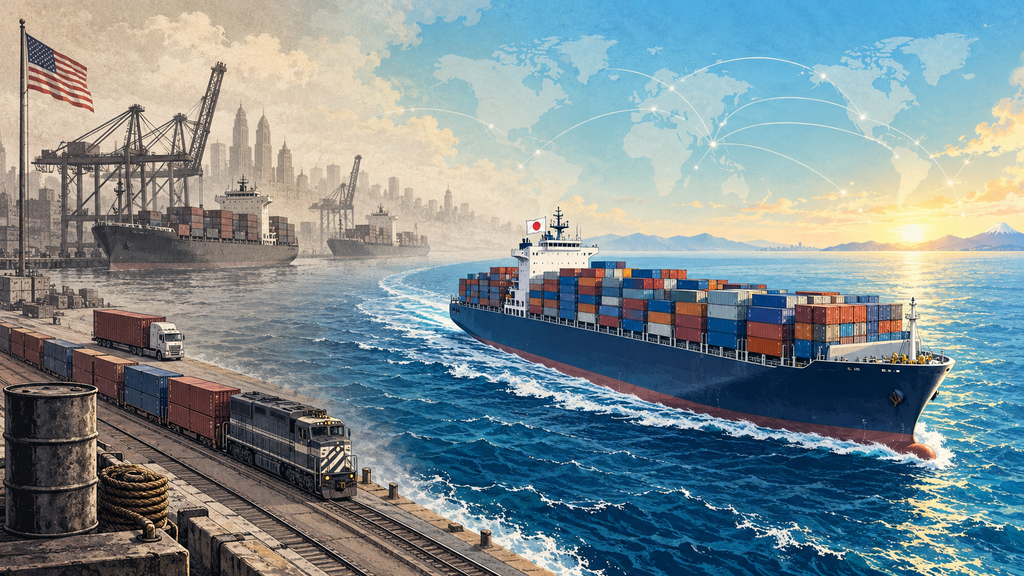
Containerization began in the United States in the 1960s. In the 1970s, Japan was regarded as the “factory of the world,” and Japanese products such as home appliances, precision machinery, and automobile parts accounted for 70% of exports to North America. New containers were manufactured in Japan and used for these exports.
At that time, major container shipping companies were dominated by U.S. flag carriers. In addition to the three U.S. mega-carriers—United States Lines (USL), American President Lines (APL), and SeaLand Service (SL)— I’m reminded of nostalgic names such as Lykes Lines, Prudential Lines, and Seatrain Lines. The 1970s were a time when U.S. container shipping companies demonstrated their overwhelming financial strength and first-mover advantage.
Malcom McLean, the founder of SeaLand, introduced eight SL-7 super-high-speed container ships capable of a maximum speed of 33 knots, connecting Yokohama and Los Angeles in just 10 to 11 days. SeaLand adopted an on-chassis system, under which containers discharged from vessels were not placed in container yards but were delivered directly to shippers by truck, enabling extremely fast delivery. However, following the oil crisis in the autumn of 1973, the service became economically unviable, forcing SeaLand to withdraw from the trans-Pacific trade. The company was eventually acquired by Denmark’s Maersk Line.
United States Lines (US Lines) built 12 vessels of 5,000 TEU each, known as “Econships,” which at the time boasted the world’s largest container-carrying capacity. As part of their eastbound round-the-world service, the vessels began calling at the Port of Yokohama in December 1984. Their imposing appearance—with the length overall of 290 meters and the beam of 32 meters, the maximum dimensions allowed under the old Panamax limits—was described as being like a huge building moving on the water. With these 12 ultra-large vessels, US Lines attempted to dominate the market through overwhelming economies of scale and lower costs from mass transportation. However, it was unable to fill their enormous cargo capacity, resulting in excess capacity and falling freight rates, and was eventually driven into bankruptcy in November 1986.
Finally, I would like to introduce American President Lines (APL). APL traces its origins to the U.S. mail steamship company established in 1840. It played a major role in promoting containerization in the United States and established an intermodal transportation system across North America by combining double-stack container trains with trucks, thereby taking the lead in logistics innovation. Unfortunately, APL was acquired by Singapore’s Neptune Orient Lines (NOL) in 1997 and ultimately became part of France’s CMA CGM in 2015.
It can be said that U.S. container shipping companies were ultimately forced to withdraw from the market because they were unable to overcome the high-cost structure resulting from U.S. regulations. We hope to see the return of strong U.S. container shipping companies that can withstand market competition and once again bring new innovations to container logistics.
Japanese container shipping companies also underwent industry consolidation in 1964, resulting in a structure dominated by six major shipping companies, which was further consolidated into three major companies in 1999. In July 2017, these three companies—NYK, MOL, and K Line—integrated their liner shipping businesses and established Ocean Network Express (ONE) in Singapore as their operating company, commencing commercial operations and services in April 2018. Today, there are no container shipping companies based in Japan providing scheduled container services between Asia and the United States or Europe. Looking at the example of Chinese and South Korean shipping companies, I believe it would be good to see the emergence of a Japanese container liner shipping company that takes a more proactive approach to competing in international trades.
China’s Export Rush Ahead of the Seven-Day Holiday — Where Are Freight Rates Heading?
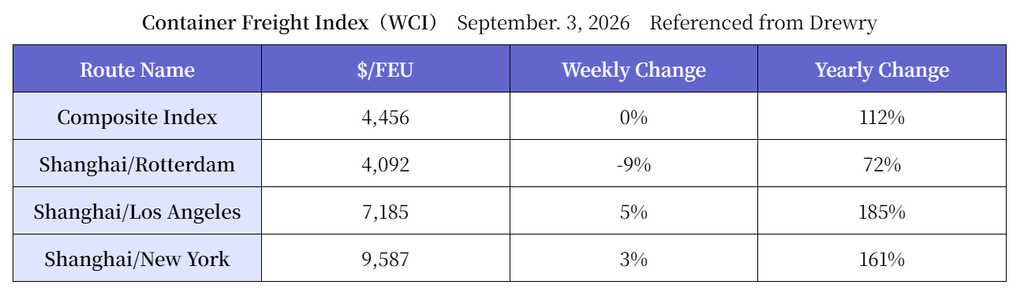
In China, the National Day holiday will run for seven consecutive days from Thursday, October 1 through Wednesday, October 7. In addition, due to the Mid-Autumn Festival, there will be a three-day holiday from Friday, September 25 through Sunday, September 27, the weekend before the National Day holiday. With these nationwide holidays occurring in close succession, the country will enter an extended holiday mood, and production activities and exports are expected to slow down. As a result, as is the case every year, a last-minute export rush and cargo surge are expected ahead of the long holiday period.
According to Drewry’s Cancelled Sailings Tracker released on September 4, 47 sailings are scheduled to be cancelled across the major East-West trade routes from Week 37 (September 7–13) through Week 41 (October 5–11), representing a cancellation rate of 6%. Of all blank sailings, 68% will be on the eastbound Transpacific trade and 15% on the Asia-Europe/Mediterranean trade. As a result, spot freight rates on the Transpacific trade are expected to remain stable as shipping lines continue to manage capacity. On the European trade, meanwhile, spot freight rates are expected to decline moderately as cargo demand slows and available capacity increases.
Freight Rates Top US$10,000 and 4.3 Million TEU Congested in Port — Extraordinary Situation Since the COVID-19 Pandemic
Short-Term Freight Rates Exceed US$10,000/FEU
According to the Shanghai Containerized Freight Index (SCFI), a short-term container freight rate index compiled by the Shanghai Shipping Exchange, short-term freight rates from Shanghai to the U.S. East Coast rose 3.6% week-on-week to US$10,040 per FEU as of August 28. This was the first time the rate had exceeded US$10,000 since June 2022, during the COVID-19 pandemic.
Global Container Fleet
According to BIMCO (Baltic and International Maritime Council), the capacity of the global container ship fleet is expected to exceed 34 million TEU during September. The fleet has expanded by 10 million TEU over the past five years. By comparison, it took more than ten years for global fleet capacity to increase from 14 million TEU to 24 million TEU. However, with more than 14 million TEU of newbuilding capacity scheduled for delivery by the end of 2030, BIMCO points out that the global container fleet could reach 44 million TEU within the next five years.
4.3 Million TEU Congested at Ports Worldwide
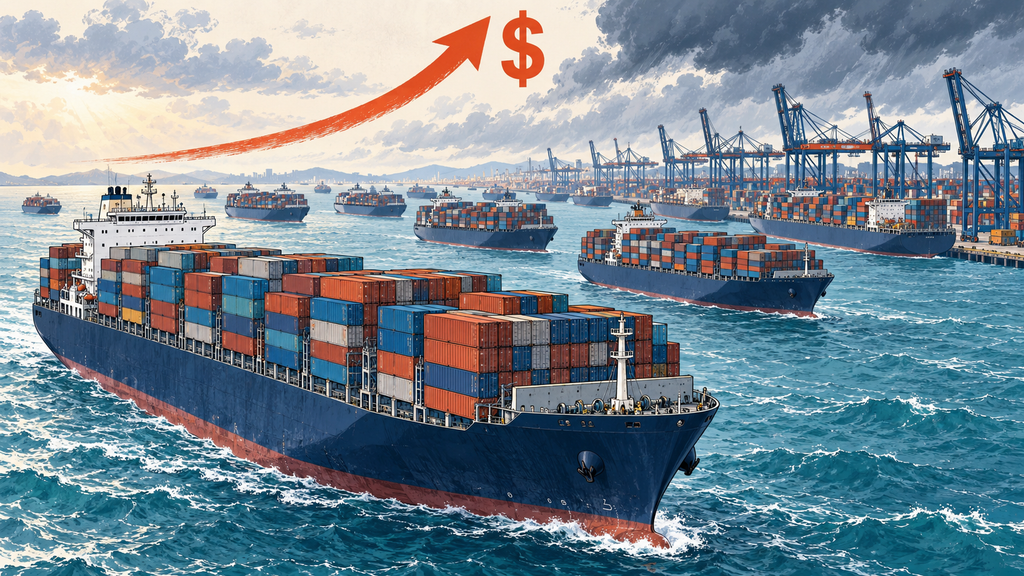
According to the latest information from LinerLytica, typhoons in East Asia have caused disruptions to container shipping schedules across the region, resulting in delays to vessel operations. Meanwhile, port strikes in Europe, strikes affecting railways and public transportation, low water levels on the Rhine and the Danube, and increasingly serious driver shortages have significantly disrupted supply chains. Restrictions on vessel transits have also been imposed due to low water levels in the Panama Canal.
As a result, more than 4.3 million TEU of container shipping capacity is currently waiting for berths at container ports around the world, with port congestion surpassing the levels recorded during the COVID-19 pandemic and reaching an all-time high. This situation is resulting to higher ocean freight rates, while vessels waiting offshore due to schedule delays are also one of the factors causing container shortages.
Nuclear Power, Rotor Sails and the Arctic Route — Three Innovations Changing the Future of Shipping
Nuclear-Powered Container Ships
Toward the decarbonization of the shipping industry, the International Atomic Energy Agency (IAEA) officially launched the ATLAS initiative on August 26 to promote the introduction of nuclear power into maritime transportation. A joint statement was signed by 28 countries, including Japan. In cooperation with the International Maritime Organization (IMO), the initiative will work toward harmonizing and standardizing safety regulations and legal frameworks, with the aim of promoting the safe use of nuclear power in commercial shipping. The initiative has opened the way for advanced Small Modular Reactors (SMRs) to become a safe and viable energy source for the shipping industry, potentially enabling high-speed maritime transportation without the need for frequent refueling.
Maersk Line to Install Rotor Sails on a Container Ship
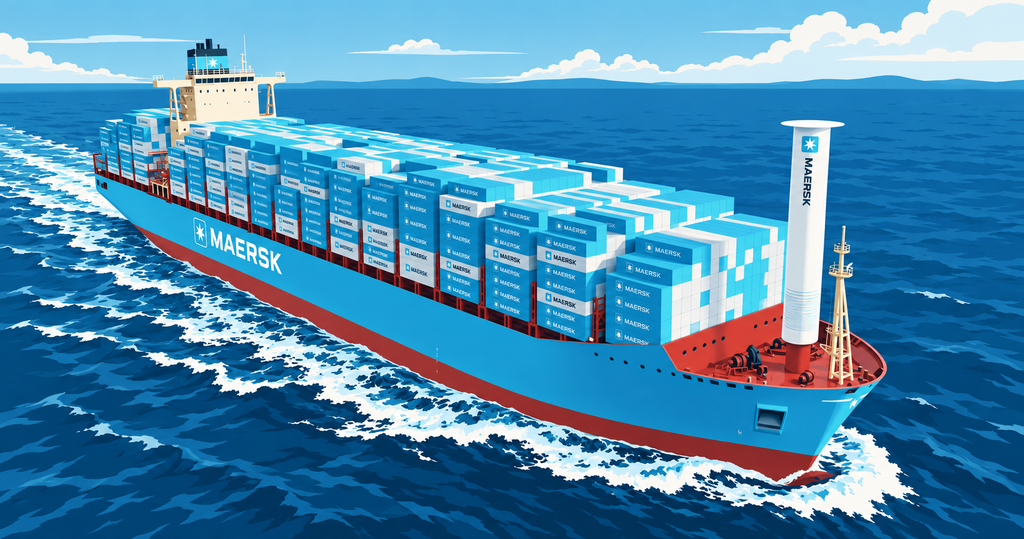
Maersk Line, the major Danish shipping company, will install a rotor sail system on an 8,700 TEU container ship scheduled to be built in 2027. The Wind-Assisted Propulsion System (WAPS), developed by Anemoi Marine Technologies, utilizes the pressure difference created by wind acting on the rotating sails as auxiliary propulsion for the vessel. Fixed cylindrical sails, each measuring 5 meters in diameter and 35 meters in height, will be installed in the forward section of the vessel in order to avoid obstructing visibility, reducing cargo-carrying capacity, or interfering with cargo-handling operations. Each rotor sail is expected to reduce fuel consumption by approximately one ton per day and CO2 emissions by approximately three tons per day. The vessel is expected to operate on North Atlantic and South Atlantic routes. This will be the world’s first installation of rotor sails on a container ship.
Sealegend Shipping Launches Arctic Route
China’s Sealegend Shipping has launched the world’s first weekly scheduled container service using the Arctic shipping route. From August 12 through October 27, seven container ships ranging from 1,528 to 4,890 TEU will be operated a total of eight voyages from Ningbo-Zhoushan Port in China to the European ports of Felixstowe in the UK, Rotterdam in the Netherlands, Wilhelmshaven in Germany, and Gdynia in Poland.
The voyage from Ningbo to Felixstowe takes 20 days, significantly shortening the transit time compared with routes via the Suez Canal or around the Cape of Good Hope. However, the Arctic route is limited to the summer season when there is less sea ice. China regards the Arctic shipping route as a “third European Route” as part of its “Polar Silk Road” strategy.
Meanwhile, environmental groups have warned that increased shipping through the Arctic could accelerate the melting of Arctic sea ice. Major European shipping companies, including France’s CMA CGM, Switzerland’s MSC, and Germany’s Hapag-Lloyd, have clearly stated that they will avoid Arctic port calls and shipping routes.
New Container Prices Stay Flat for Six Months — Production Quietly Passes Its Peak
The price of newly built containers in August remained unchanged from the previous month at US$1,750 per 20f. Although steel prices fell by 1% month-on-month while flooring material prices rose by 5.4%, the container price remained unchanged. This means that new container prices have now remained unchanged for six consecutive months.
New container production in August totaled 769,480 TEU (Dry: 731,477 TEU; Reefer: 38,003 TEU). Compared with the previous month, total production increased by 2,294 TEU (Dry: +590 TEU; Reefer: +1,704 TEU). In percentage, total production was virtually unchanged at 0% (Dry: 0%; Reefer: +4.7%). Both Dry and Reefer production increased slightly from the previous month. Following last month, August recorded the second-highest monthly production volume over the past year. Could this have been speculative ordering ahead of anticipated increases in raw material prices? We need to keep a close watch on new container prices from September onward.
At the end of August, factory inventories of new containers stood at 1,373,536 TEU (Dry: 1,305,414 TEU; Reefer: 68,122 TEU). Compared with the previous month, total inventories decreased by 29,747 TEU (Dry: -33,895 TEU; Reefer: +4,148 TEU), representing a decrease of 2.1% overall (Dry: -2.5%; Reefer: +6.5%).
Factory shipments in August totaled 799,227 TEU (Dry: 765,372 TEU; Reefer: 33,855 TEU), making August the second-highest shipment month of this year, following last month. It therefore appears that both container production and factory shipments for this year peaked last month and are likely to decline from now on.
Verified by NKKK, Installed in Just 5 Minutes — A Thermal Liner to Protect Your Cargo
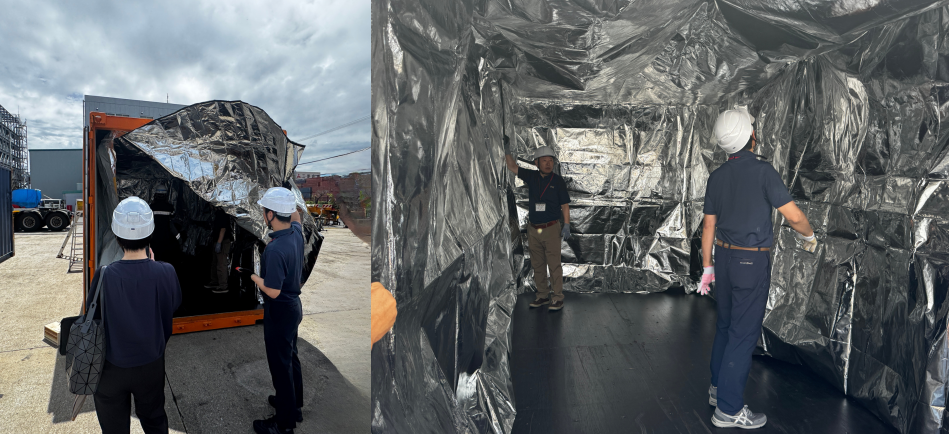
From Friday, August 14 through Monday, August 17, we conducted a demonstration test of Embatuff, an insulated container thermal liner (insulation sheet) manufactured by Embalex, a Spanish entity who provides Industrial packaging and comprehensive logistics, and for which our company serves as the exclusive distributor, at the Oi Container Terminal in Tokyo. We asked the Nippon Kaiji Kentei Kyokai (NKKK), an independent third-party inspection organization, to verify the test. A total of 18 people participated, including visitors mainly from logistics companies, members of the media, and our company staff. Although rain had been forecast until the day before the test, the weather was cloudy with occasional sunshine, with a maximum temperature of 31.2℃ and a minimum of 26.7℃. While the conditions did not reach the extreme heat typical of midsummer, we were able to successfully complete the four-day test. We would once again like to express our sincere appreciation to everyone who cooperated with us.
We were also able to confirm that Embatuff could be installed in approximately five minutes, as demonstrated in Embalex’s demonstration video. Based on the temperature measurements taken over the four-day period, we also received confirmation from NKKK that “Embatuff can be expected to mitigate and delay the effects of rapid temperature changes.”
The Embatuff insulated container thermal liner is designed primarily to protect cargo from irreversible damage caused by high temperatures and humidity. It also isolates cargo from odors and dust, providing a hygienic environment, and can be reused. Products and commodities that are sensitive to temperature changes and have previously had to be exported in refrigerated containers (REF containers) can now potentially be transported in ordinary DRY containers, offering significant cost savings, including ocean freight costs. We encourage you to give Embatuff a trial.