
Headlines
- 1) Diesel Prices Hit Record Highs, Oil Reserves to Be Released — Soaring Energy Costs Weigh on U.S. and European Economies
- 2) Trump Moves Ahead of Midterm Elections — Unusually Warm Welcome for President Xi and a Pledge of $5,000 per Adult
- 3) End of More Than Two and a Half Years of Cape of Good Hope Diversions? — Major Shipping Lines Return to the Red Sea and Suez Canal
- 4) Mega Container Ships Arrive on the U.S. West Coast, with the LOA 414m “Gigamax” Next — How Much Can Container Ships Jumboize?
- 5) Less Cargo, More Ships — Downward Pressure on Container Freight Rates After China’s Long Holidays
- 6) New Container Prices Rise to $1,850 — September Records Year’s Highest Production and Shipment Volumes
- 7) Three Consecutive Years of Nobel Prize Awards for Japan — Tokyo University of Science Professor Emeritus Kenso Soai Wins Nobel Prize in Chemistry
1) Diesel Prices Hit Record Highs, Oil Reserves to Be Released — Soaring Energy Costs Weigh on U.S. and European Economies
According to the September employment report released by the U.S. Department of Labor on October 2, nonfarm payroll employment increased by 29,000 from the previous month. However, this fell short of market expectations of an increase of 80,000 to 90,000. Employment figures for the previous two months, July and August, were also revised significantly downward. The unemployment rate rose to 4.2%, up 0.1 points from August. As a result, the possibility of an interest rate hike by the Federal Reserve (FRB) at the end of this month appears to have diminished. Labor supply and demand are not considered tight enough to cause wage increases and generate inflationary pressure. Nevertheless, the U.S. economy remains strong.
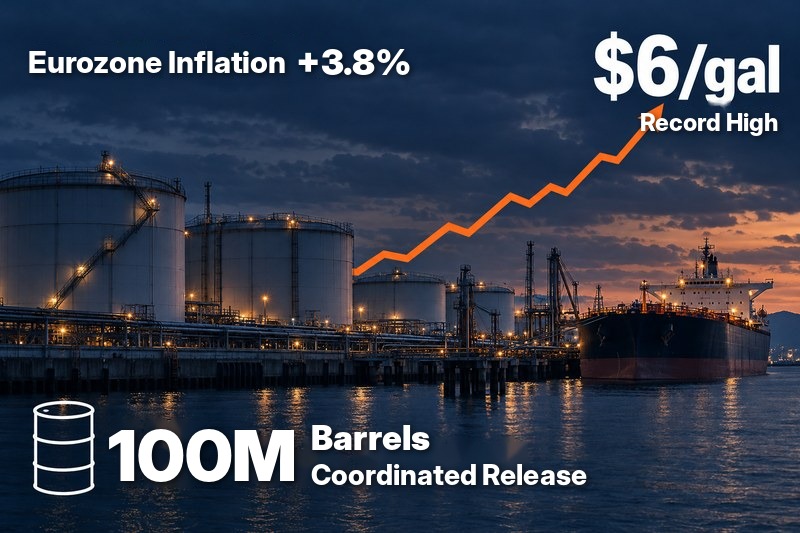
Meanwhile, according to the preliminary figures for September’s Eurozone Consumer Price Index (HICP: Harmonized Indices of Consumer Prices) released by Eurostat, the statistical office of the European Union (EU), on October 2, consumer prices rose by 3.8% year-on-year, exceeding the European Central Bank’s inflation target of 2% for the seventh consecutive month. The increase in energy costs accelerated further to 18.8%, compared with 14.3% in August. As energy costs continue to rise, there are growing concerns about a resurgence of inflation.
In the United States, the national average price of diesel fuel exceeded $6 per gallon in mid-September for the first time in history, setting a new record high. Ahead of the midterm elections in November, U.S. President Trump, seeking to dispel inflation concerns caused by persistently high diesel fuel prices, pressured the Group of Seven (G7) nations on October 2 and persuaded them to agree on a coordinated release of 100 million barrels of strategic petroleum reserves.
2) Trump Moves Ahead of Midterm Elections — Unusually Warm Welcome for President Xi and a Pledge of $5,000 per Adult
On September 23, U.S. President Trump extended an unusually warm welcome to Chinese President Xi Jinping, who arrived at Joint Base Andrews outside Washington, treating him as a state guest and personally greeting him with a handshake. The two leaders held discussions on the provisional extension of their trade agreement, artificial intelligence (AI), and international affairs, including the situation in the Middle East. It is believed that President Trump chose stability over confrontation in an effort to reassure the markets ahead of the November 4 midterm elections.
Furthermore, U.S. President Trump has pledged to provide a substantial cash payment of $5,000 per adult if the Republican Party wins the midterm elections and maintains its majority in Congress. He has announced this proposal as an appeal to voters just before the elections. However, it would require an enormous amount of financial resources totaling $1.2 trillion (approximately 180 trillion yen at US$1.00 = ¥150), raising questions about how it would be funded and whether it would be legally justified. With inflation accelerating following the attacks on Iran, public dissatisfaction growing, and the ruling Republican Party facing increasing headwinds, will the November 4 midterm elections give President Trump the political strength he needs?
3) End of More Than Two and a Half Years of Cape of Good Hope Diversions? — Major Shipping Lines Return to the Red Sea and Suez Canal
Shipping Lines Resume Services One After Another, with CMA CGM Leading the Way
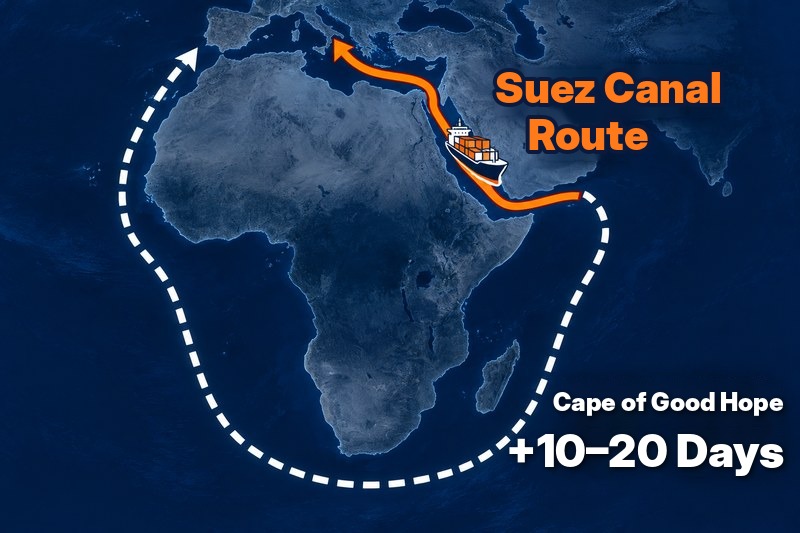
I would like to focus on the reasons why the major shipping lines and alliances operating on the Asia–Europe trade routes have begun returning to the Red Sea and Suez Canal routes almost simultaneously.
On the Asia–Europe trade routes, major shipping lines had suspended transit through the Red Sea and Suez Canal since December 2023 and continued operating their services via the Cape of Good Hope to avoid the impact of the conflict between Israel and Hamas, which began on October 7, 2023. However, despite the continuing instability and risks in the region, major shipping lines have been shifting their vessel operations back to the Red Sea and Suez Canal routes since August, as if the floodgates had suddenly opened.
MSC (operating independently) resumed operations via the Red Sea and Suez Canal on August 24, followed by Gemini Cooperation (Maersk and Hapag-Lloyd) in mid-September, Ocean Alliance (CMA CGM, COSCO, OOCL and Evergreen) in October, and Premier Alliance (ONE, Yang Ming and HMM), which plans to resume operations on October 17.
However, even after other shipping lines diverted their vessels via the Cape of Good Hope, CMA CGM continued to use the Red Sea and Suez Canal routes on a limited basis, with assistance from the French Navy and others. CMA CGM is said to have been the only major container carrier that did not completely abandon the Red Sea route.
Therefore, CMA CGM’s continued use of the Suez Canal throughout 2025 and the first half of 2026 can be regarded as one of the factors that encouraged other shipping lines and alliances to decide to return to the Red Sea and Suez Canal routes from August onward.
The Biggest Reason: “Too Many Ships”
There are several other factors that have prompted major shipping lines to return to the Red Sea and Suez Canal routes. One of them is the increase in the delivery capacity of newly built container ships.
| Actual and Forecast Deliveries Based on Data from Major Research Institutions | ||
| Year | Vessel Delivery Capacity | Estimated Number of Vessels |
| 2024 | Approx. 2.90 million TEU (Record High) | Approx. 450–500 |
| 2025 | Approx. 2.00–2.10 million TEU | Approx. 300–350 |
| 2026 | Approx. 1.50–1.70 million TEU | Approx. 250–300 |
| Total (2024-26) | Approx. 6.40–6.70 million TEU | Approx. 1,000–1,150 |
| 2027 | Approx. 2.80–3.00 million TEU | Approx. 400–500 |
The massive deployment of ultra-large container ships with capacities of 20,000–24,000 TEU, mainly by MSC, CMA CGM, COSCO and Evergreen, appears to have made the surplus vessel capacity, which had been absorbed by the Cape of Good Hope route and is estimated at 6–9% of the global fleet capacity, the most significant economic factor behind the return to the Suez Canal route.
According to BIMCO (Baltic and International Maritime Council), the total global container ship fleet capacity stood at 34 million TEU as of September 2026. Therefore, the surplus vessel capacity is estimated at 2.04–3.06 million TEU. This oversupply has become a major factor contributing to the decline in freight rates on the Asia–Europe trade routes. Freight rates on these routes have fallen for 12 consecutive weeks, reflecting the expected decline in Chinese exports following the suspension of production activities during the Mid-Autumn Festival and National Day holidays, which began at the end of September.
A Longer Route with 30% Higher Fuel Costs, or a Risky Shortcut?
The Cape of Good Hope route is safer, but it requires an additional 10–20 days of sailing time, resulting in approximately 30% higher fuel costs. Furthermore, the risk of delays is greater. On the other hand, although the situation surrounding the Red Sea and Suez Canal route remains unstable, the fact is that its operating costs are significantly lower than those of the Cape of Good Hope route. It is said that using the Suez Canal route is more profitable, even with the risks involved.
There is also competition and peer pressure among shipping lines and alliances. Therefore, a full-scale return to the Red Sea and Suez Canal route is considered an inevitable and rational choice.
Meanwhile, even after the major shipping lines and alliances returned to the Suez Canal route in the second half of 2026, strikes and insufficient cargo-handling capacity at major European ports have become increasingly evident, resulting in longer vessel waiting times and continued port congestion in Europe. Port congestion and insufficient handling capacity appear to be providing some support for freight rates, preventing them from falling further. However, the delivery of approximately 2.8–3.0 million TEU (around 400–500 vessels) of newly built container ships in 2027, possibly the largest volume in history, could become another factor contributing to further instability in freight rates on the Asia–Europe trade routes.
4) Mega Container Ships Arrive on the U.S. West Coast, with the LOA 414m “Gigamax” Next — How Much Can Container Ships Jumboize?
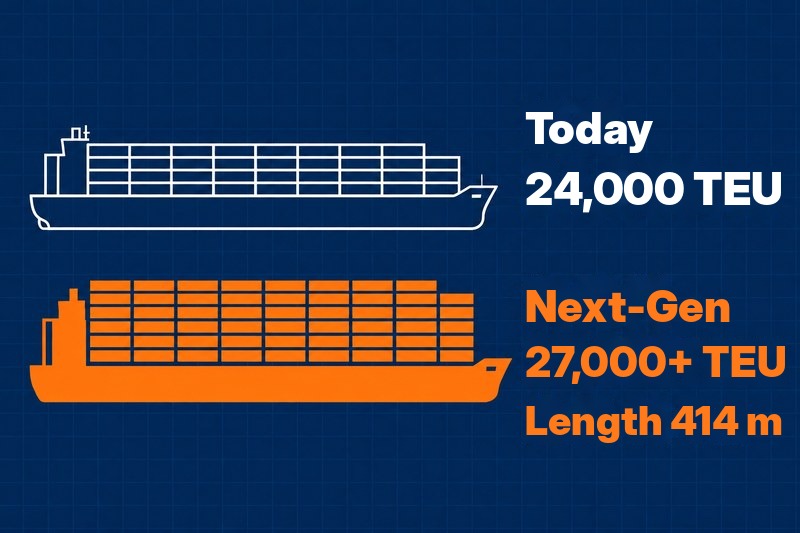
On September 26, a 23,656 TEU container ship operated by MSC called at the Port of Long Beach in the United States. Mega container ships have now begun calling at U.S. ports. A large number of mega container ships delivered between 2023 and 2026 had previously been deployed almost exclusively on the Asia–Europe trade routes. However, it appears that shipping lines now have no choice but to redeploy surplus mega container ships from the Asia–Europe trade routes to the Asia–U.S. West Coast and Mexico trade routes. The ports of Vancouver on the North American West Coast, Long Beach in the United States, and Manzanillo in Mexico are already equipped to accommodate mega container ships. I believe we can now say that a new era of mega container ships has begun at U.S. West Coast ports.
According to French maritime research firm Alphaliner, container ships with even greater carrying capacity than the current largest container ships, the Megamax-24 (24,000 TEU mega container ships), may emerge after 2030. Advances in ship design technology, efforts by major shipping lines to improve cost efficiency, and environmental considerations are expected to accelerate the development of even larger 25,000 TEU vessels, known as Gigamax-25. The anticipated dimensions and specifications include a LOA (length overall) of 414 meters, a beam of 63.3 meters, 25 cargo holds, 25 container rows across the deck, and 13 tiers of containers on deck with higher lashing bridges. Furthermore, by adding an extra bay above the forecastle to increase container stowage space, it would be possible to build container ships with a capacity exceeding 27,000 TEU while maintaining the basic dimensions of the Gigamax-25.
Rising fuel prices and increasingly stringent decarbonization regulations appear to be driving strong demand for larger container ships. Several major shipping lines are reportedly already discussing orders to be placed before the end of this year with shipbuilders. Maersk and Hapag-Lloyd, which together form Gemini Cooperation, are considered the most likely candidates. It appears that Chinese shipyards will receive orders for these new-generation Giga-Jumboized vessels.
5) Less Cargo, More Ships — Downward Pressure on Container Freight Rates After China’s Long Holidays
| Drewry World Container Index – October 1, 2026 Container Freight Rate Index — Source: Drewry | |||
| Trade Route | US$/FEU | WoW Change | YoY Change |
| Composite Index | 4,434 | -1% | +166% |
| Shanghai – Rotterdam | 3,399 | -2% | +111% |
| Shanghai – Los Angeles | 7,835 | 0% | +257% |
| Shanghai – New York | 10,428 | +1% | +226% |
Notes: WoW = Week-on-Week; YoY = Year-on-Year; FEU = Forty-foot Equivalent Unit.
In China, the Mid-Autumn Festival (September 25–27) and National Day holidays (October 1–7) followed one another, resulting in an extended holiday period during which factories suspended operations. In addition, as cargo volumes are expected to decline considerably after the holidays, spot freight rates on the Transpacific trade routes are also expected to fall. However, it has been pointed out that an extension of the U.S.–China trade truce could help support a recovery in demand for shipments to the United States.
Meanwhile, on the Asia–Europe trade routes, the number of container ships transiting the Suez Canal has been increasing, putting downward pressure on freight rates. Freight rates have declined for 12 consecutive weeks, reflecting sluggish demand. Therefore, major shipping lines are planning to raise FAK (Freight All Kinds) rates, which are applied at a uniform rate regardless of cargo type, in the second half of October. For the time being, freight rates on the Asia–Europe trade routes are expected to remain unstable due to uncertainty surrounding the activities of the Houthis, an Iran-backed armed group in Yemen, and disruptions in the Strait of Hormuz.
6) New Container Prices Rise to $1,850 — September Records Year’s Highest Production and Shipment Volumes
The price of newly built containers in September rose by $100, or 5.7%, from the previous month to $1,850 per 20-foot container. This was due to increases in the prices of steel, flooring materials and paint, which rose by 1.6%, 1.8% and 5.3%, respectively, from the previous month. Since reaching $1,550 per 20-foot container in February 2025, new container prices have been on a gradual upward trend.
New container production in September totaled 809,842 TEU (Dry: 771,795 TEU, Reefer: 38,047 TEU). Compared with the previous month, production increased by 40,362 TEU (Dry: +40,318 TEU, Reefer: +44 TEU). In percentage terms, total production increased by 5.2% (Dry: +5.5%, Reefer: approximately 0%). In the end, this year appears to be following the usual annual pattern, with September recording the highest monthly production volume of dry containers so far this year.
At the end of September, inventories of newly built containers at manufacturing plants stood at 1,208,710 TEU (Dry: 1,147,500 TEU, Reefer: 61,210 TEU). Compared with the previous month, total inventories decreased by 164,826 TEU (Dry: -157,914 TEU, Reefer: -6,912 TEU). In percentage terms, total inventories declined by 12.0% (Dry: -12.1%, Reefer: -10.1%).
Factory shipments in September totaled 974,668 TEU (Dry: 929,709 TEU, Reefer: 44,959 TEU). As a result, somewhat unexpectedly, September turned out to be the month with the highest shipment volume so far this year.
7) Three Consecutive Years of Nobel Prize Awards for Japan — Tokyo University of Science Professor Emeritus Kenso Soai Wins Nobel Prize in Chemistry

On the evening of 7th October, I received some very encouraging news. Professor Emeritus Kenso Soai (76) of Tokyo University of Science was selected as this year’s Nobel Prize in Chemistry. As he belongs to a generation younger than mine, I am particularly delighted by this news. This marks the third consecutive year that Japan has won Nobel Prize laureates. In 2024, Nobel Peace Prize was awarded to Nihon Hidankyo (Japan Confederation of A- and H-Bomb Sufferers Organizations), followed by Nobel Prize in Chemistry awarded to Professor Susumu Kitagawa in 2025, and now to Professor Kenso Soai in 2026. This also marks the second consecutive year that Japanese scientists have awarded Nobel Prize in Chemistry. With this latest award, Japan now has 31 individual Nobel Prize laureates and one organization. I am extremely proud of this achievement. I sincerely hope that more Japanese people will continue to make valuable contributions to people around the world.